
 FAQ
FAQ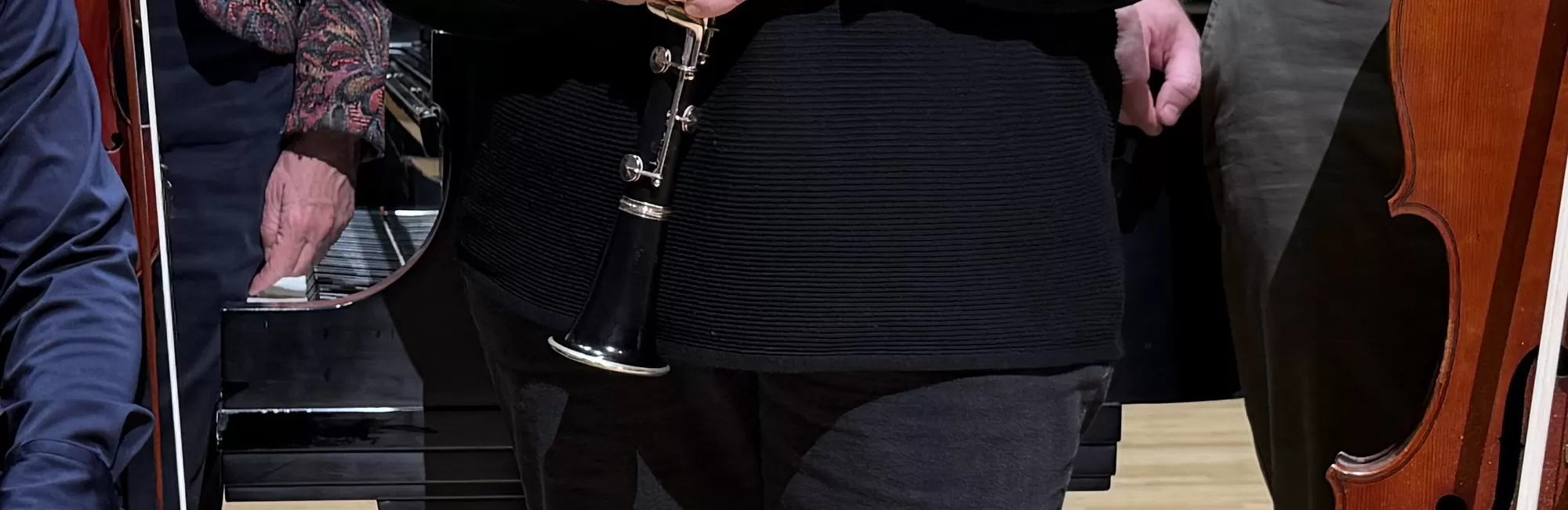
Concerts
Cal Poly Recital Series: Vipisa Trio
Cal Poly Recital Series: Vipisa TrioA Sense of the Eternity
The Cal Poly Humboldt Department of Dance, Music, and Theatre presents “The Cal Poly Humboldt Recital Series: Vipisa Trio with special Guest Garrick Woods.” The Trio (Cindy Moyer, violin/viola, Simon Oh, piano, Virginia Ryder, clarinet) will be performing works by Mozart, Jennifer Higdon, Vipisa member Simon Oh, and—most excitingly—Quartet for the End of Time by Oliver Messian. Join us Sunday April 26th at 7:30 pm at the Fulkerson Recital Hall. Tickets are $20 General, $5 Child, and $5 for Cal Poly Humboldt Students with ID. Tickets can be purchased at the door or online at tickets.humboldt.edu/dance-music-and-theatre.
The first half of the evening is devoted solely to Quartet pour la fin du temps (Quartet for the End of Time) by Olivier Messian one of the leading French composers of the 20th century, as well as a fervent Catholic mystic and passionate amateur ornithologist. During World War II, Messiaen volunteered as an ambulance driver; he was captured in 1940 and spent 9 months in a German prisoner of war camp, where he wrote this piece, which was inspired by these excerpts from the Book of Revelation (Chapter 10: 1-7) “Then I saw another mighty angel coming down from heaven. He was robed in a cloud, with a rainbow above his head; his face was like the sun, and his legs were like fiery pillars… He planted his right foot on the sea and his left foot on the land…. Then the angel I had seen standing on the sea and on the land raised his right hand to heaven. and he swore by him who lives for ever and ever, who created the heavens and all that is in them… But in the days when the seventh angel is about to sound his trumpet, the mystery of God will be accomplished.
Massien said of the piece, “Conceived and written in the course of my captivity, the Quartet for the End of Time was performed for the first time in Stalag 8-A on January 15, 1941, by Jean Le Boulaire, violinist; Henri Akoka, clarinetist; Etienne Pasquier, cellist; and myself at the piano. Its musical language is essentially transcendental, spiritual, catholic. Certain modes, realizing melodically and harmonically a kind of tonal ubiquity, draw the listener into a sense of the eternity of space or time. Particular rhythms existing outside the measure contribute importantly toward the banishment of temporalities. (All this is mere striving and childish stammering if one compares it to the overwhelming grandeur of the subject!)
This Quartet contains eight movements. Why? Seven is the perfect number, the creation of six days made holy by the divine Sabbath; the seventh in its repose prolongs itself into eternity and becomes the eighth, of unfailing light, of immutable peace.”
Following intermission, the program continues with Distorted Scherzo by trio member and staff accompanist Simon Oh. “For centuries, the scherzo has been a beloved vehicle for composers to explore rhythmic ingenuity. Traditionally characterized by its playful nature and triple meter, the form often invites composers to subvert expectations through accents that obscure the underlying three-beat pulse.” says Oh. “Distorted Scherzo (2026) serves as a modern experiment in this tradition. While honoring the spirited essence of the scherzo, the work introduces frequent meter changes to create a sense of calculated irregularity. At its core, the piece is a study in unity and transformation: multiple melodic strands are derived from a singular tonal structure. By varying rhythm, harmony, articulation, and accompaniment, the work demonstrates the expansive possibilities inherent in a single musical cell.” This piece was composed specifically for the “Vipisa Trio”.
Trio in E-flat Major, K. 498, “Kegelstatt” by Wolfgang Amadeus Mozart follows. “While many celebrated works exist for the combination of clarinet, viola, and piano, Wolfgang Amadeus Mozart was the first to pioneer this unique instrumentation. The ‘Kegelstatt’ Trio was born of a personal, domestic setting: Mozart composed it for his gifted pupil Franziska von Jacquin (piano) and his close friend Anton Stadler (clarinet), reserving the viola part for himself. This intimate origin infuses the work with a characteristic charm and warmth.
The first movement deviates from the typical high-energy opening of the Classical sonata; instead, its Andante tempo and transparent texture offer a graceful introduction. The second movement is a refined Menuetto. Although it features a darker, minor-key Trio section, the driving triplets maintain the work's lively momentum. The finale, a Rondo: Allegretto, concludes the piece with a playful spirit and virtuosic flourishes across all three parts.
The nickname ‘Kegelstatt’ refers to a skittles alley, the ancestor of modern bowling. While Mozart likely applied this nickname to a set of horn duets composed while playing the game, tradition has firmly attached it to this trio. Though perhaps a historical misattribution, the name remains a fitting tribute to the trio's convivial and friendly nature.” (Notes written by Simon Oh)
The program concludes with Dash by Jennifer Higdon who writes the following about her piece, “Dash comes at the beginning of the 21st Century, where speed often seems to be our goal. This image fits well the instruments in this ensemble, clarinet, violin, and piano, because these are some of the fastest moving instruments in terms of their technical prowess. Each individual plays an equal part in the ensemble, contributing to the intensity and forward momentum, as the music dashes from beginning to end.” This work was commissioned in 2001 by the Verdehr Trio with funding provided by Michigan State University.
When: April 26th at 7:30pm
Where: Fulkerson Recital Hall
Price: $20 General, $5 Students/Seniors and Cal Poly Humboldt students with ID
Ticket Purchase: tickets.humboldt.edu/dance-music-and-theatre
Contact: Cal Poly Humboldt School of Dance, Music, and Theatre, 707-826-3566, mus@humboldt.edu